How to Listen to Indian Radio Online (Bollywood, Classical and AIR)
Updated

You can stream Indian radio online from any browser, anywhere in the world, with no download and no account required to begin. Open 72FM's India page and press play. India's radio landscape is one of the most varied on earth — spanning hundreds of languages, classical systems of extraordinary depth, a commercial film-music tradition that has produced some of the most listened-to music of the 20th and 21st centuries, and a public broadcasting network that covers the subcontinent in remarkable geographic and linguistic breadth. Exploring Indian radio is not a matter of minutes — it's a longer-term project, and a rewarding one.
All India Radio: a network unlike any other
All India Radio (AIR), known in Hindi as Akashvani ("voice from the sky"), is the public broadcasting network of India and one of the largest radio organisations in the world. It broadcasts in dozens of Indian languages and dialects, covering news, classical music, folk music, drama, and cultural programming. Its reach into rural India has historically made it a genuinely public medium in a way that commercial radio rarely is — bringing broadcasting to communities far from urban centres.
AIR's classical programming is particularly notable. Both Hindustani and Carnatic classical traditions have been integral to its cultural mission since its early decades, and listening to AIR's music broadcasts can feel like an introduction to an entirely different world of musical thought — one that has been evolving over centuries.
The sounds worth knowing
Hindustani classical: the northern tradition
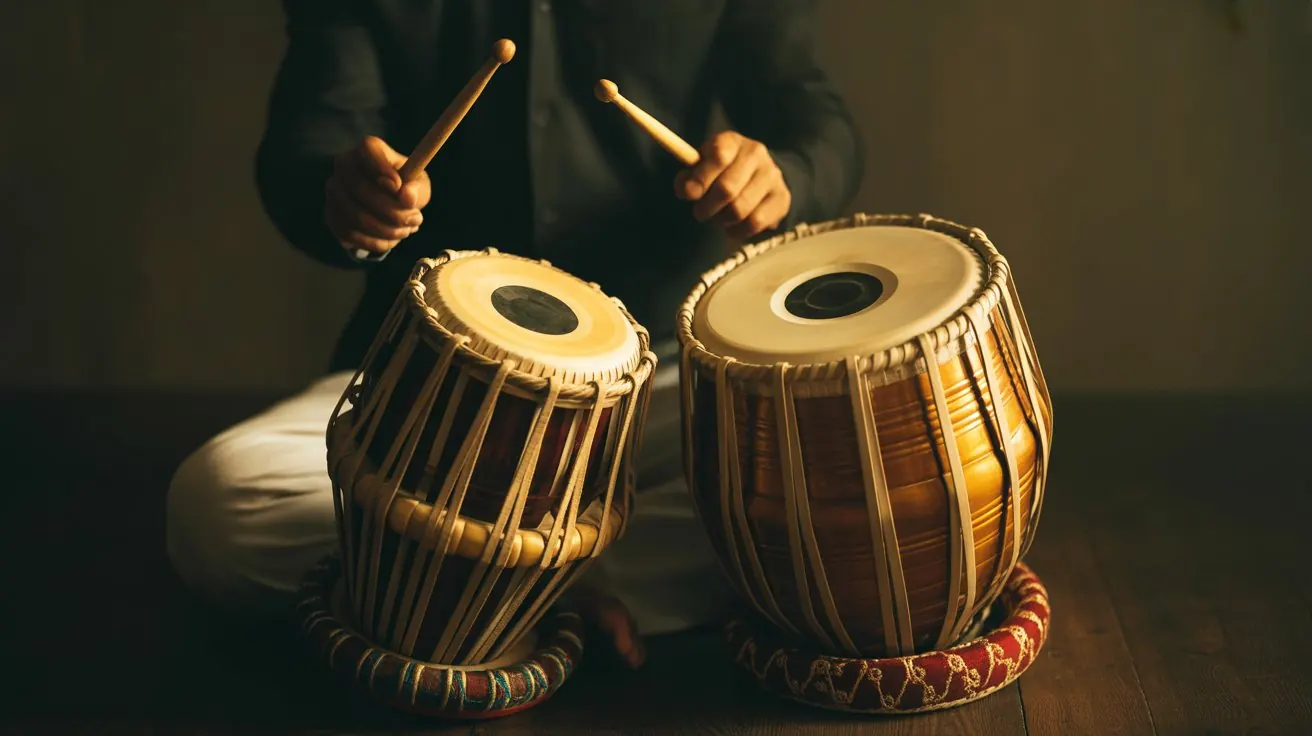
The Hindustani classical tradition — predominant in northern, western, and eastern India — is built on an elaborate system of ragas (melodic frameworks) and talas (rhythmic cycles), within which performers improvise over extended durations. A full Hindustani performance may last from thirty minutes to several hours; the opening alap (an unhurried, unmetered melodic exploration) can alone span many minutes before rhythm enters. Artists associated with this tradition — sitarists like Ravi Shankar, vocalists in the khayal style, sarod and tabla players — have built devoted audiences around the world. Hearing this music on radio, as part of a programme context rather than as an isolated recording, adds a layer of cultural framing that is worth experiencing.
Carnatic classical: the southern tradition
South India's classical tradition — Carnatic music — shares some philosophical roots with Hindustani music but is a genuinely distinct system. It is more strictly composed in structure, with a vast repertoire of kritis (devotional compositions) that performers interpret with great finesse. The tradition encompasses vocalists, veena players, violin players (the violin was absorbed into Carnatic music in the 18th and 19th centuries and sounds quite different from its European counterpart here), mridangam drummers, and more. AIR's southern stations and specialist Carnatic streaming services keep this tradition alive and available.
Film music: the Bollywood dimension
Indian film music — loosely called Bollywood, though more accurately it spans the Hindi-language film industry and several large regional industries including Tamil, Telugu, Malayalam, and others — is perhaps the most-listened-to music tradition in the world by sheer audience size. The songs that accompany Indian cinema have shaped popular taste across the subcontinent and its diaspora for a century, from the playback singers of the golden era (Lata Mangeshkar, Mohammed Rafi, Kishore Kumar) through the fusion experiments of the 1990s to the contemporary industry's range of pop, hip-hop, and electronic production. Film-music radio is among the most popular commercial formats in India. The Bollywood Beats collection on 72FM is a useful starting point if this is where you want to begin.
Regional and folk music
India's folk and regional music traditions are too numerous and diverse to summarise briefly. Rajasthani folk, Punjabi bhangra, Bengali baul music, Goan fado influences, tribal and indigenous musical traditions across northeast India — each is a substantial tradition in its own right. Regional commercial stations often reflect local folk heritage more directly than the national networks. Exploring regional stations is one of the most rewarding things you can do on the Indian page.
How to start listening
- Go to the India page. Visit /radio/in in any browser — phone, laptop, or tablet. No app needed.
- Choose an entry point. If Bollywood is familiar ground, start there; if you'd like to explore the unfamiliar, try classical or folk programming.
- Save what surprises you. Add stations to your favourites — up to ten on the free tier — so you can return without searching again.
For a broader world-music context, the radio map gives you a geographic way into the subcontinent, and the world music radio guide connects Indian music to the wider global discovery picture.
Indian radio and the diaspora
For members of the Indian diaspora — among the world's largest — radio from home carries a particular weight. Language, music, familiar voices, and the rhythm of programming shaped in childhood are not trivial things. Commercial Indian radio stations operating internationally cater specifically to diaspora communities in the UK, US, Canada, and elsewhere; AIR's international streaming makes the original broadcasts accessible too. If Indian radio for you is about connection rather than curiosity, that is equally a valid and important kind of listening.
If a stream won't play
Some Indian broadcasting streams, particularly certain AIR programmes, may be restricted by region. If a station won't load, it's a broadcaster-level decision; try another on the India page. The directory is extensive, and alternatives are generally available.
In short
Indian radio online is one of the most genuinely diverse listening experiences available anywhere — ancient classical systems, century-old film music traditions, and a multilingual regional landscape that takes a lifetime to explore properly. Open the India page, pick a direction, and begin.
Browse Indian stations on 72FM and let the subcontinent's sound unfold.
Listen now: All stations from India
Frequently asked questions
Is Indian radio free to listen to online?
Yes. On 72FM, public-directory Indian stations are free to stream in any browser, with no account and no download required. The player has no ads or tracking on either tier; Premium lifts the one-hour daily limit and adds unlimited favourites.
What is All India Radio?
All India Radio (AIR), or *Akashvani*, is the national public broadcaster of India. It operates networks across dozens of languages and covers music, news, drama, and cultural programming on a vast geographic scale.
What is the difference between Hindustani and Carnatic classical music?
Both are ancient Indian classical traditions, but they developed differently over centuries. Hindustani music is predominant in the north and is more improvisation-focused; Carnatic music is centred in the south and has a more extensive composed repertoire. Both are profound and worth exploring slowly.
Is there a good place to start with Indian radio if I'm unfamiliar with it?
Yes — start with a film music or Bollywood station for familiarity, then move to folk or regional stations for variety. The [Bollywood Beats collection](/collection/bollywood-beats) on 72FM is a useful first step.
Can Indian radio help with language learning?
India's multilingual broadcasting makes it useful for learners of Hindi, Tamil, Kannada, Bengali, and many other languages. AIR's Hindi news and cultural broadcasts are particularly useful for Hindi learners.